
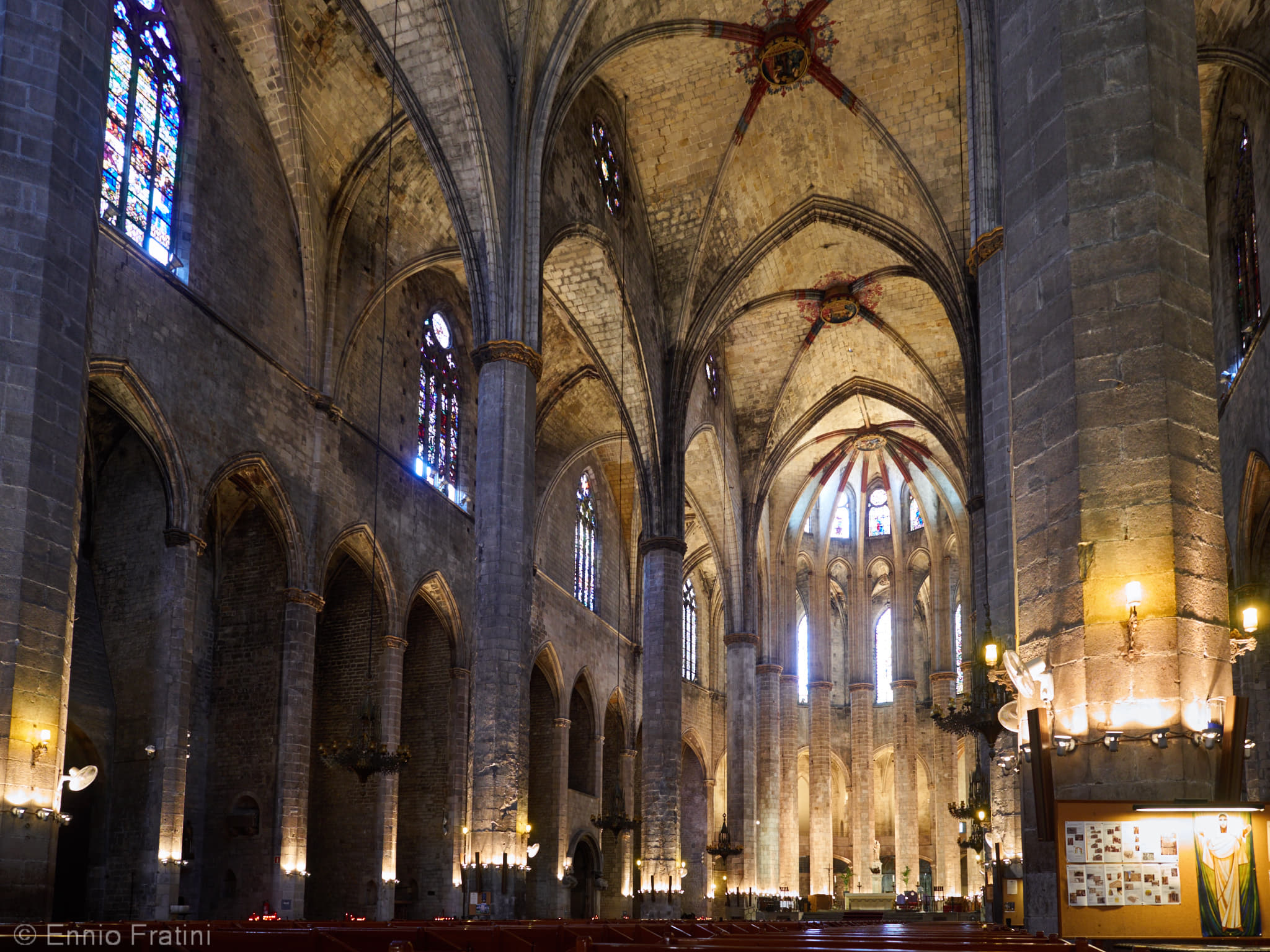


Overview of Basilica of Santa María del Mar
History of Basilica of Santa María del Mar

Located in the bustling Ribera district of Barcelona, the Basilica of Santa María del Mar stands as a testament to Catalonia's golden age of maritime and mercantile dominance. Constructed between 1329 and 1383, it epitomises the Catalan Gothic style, exuding a rare purity and cohesion in its architectural detailing. Its origin traces back to the early Christian community established near the sea in Roman-era Barcino. By the end of the seventh century, a modest chapel, once called Santa Maria de Les Arenes, evolved into the renowned "Santa Maria del Mar", reflecting the area's profound connection to the sea.
Church's legacy is deeply interwoven with the common people, especially the Bastaixos – the dockworkers of La Ribera. These dedicated souls transported enormous stones from Montjuïc’s royal quarry, on their backs, right to the church's construction site. Their contribution is immortalised in the church's very fabric, from the capitals to the bronze trims on its doors. Despite the adversities it faced - from the devastating 1428 earthquake to the fiery wrath of the Spanish Civil War in 1936, the basilica stands resilient. As visitors wander amidst its towering arches and pillars, the sheer grandeur and history of Santa María del Mar promises a breathtaking experience.
Highlights of Santa Maria del Mar Architecture

- When you step inside Basílica Santa Maria del Mar, the vastness of its three naves and thirty-three chapels takes your breath away.
- It's not your typical Gothic church, since the way they built it shows a whole new take on the classic Gothic style.
- The Montjuïc stone, integral to Barcelona's history, forms the very essence of this church, transporting you back in time.
- Everywhere you turn, there are tributes to the Bastaixos, the unsung heroes who hauled the stone from Montjuïc.
- The crypt of Santa Maria del Mar uncovers an early Christian necropolis, suggesting the location's religious significance since the 4th century.
- The basilica stands as a testament to 14th-century Catalan Gothic architecture, emphasising horizontal structure and imparting a unique feel of lightness.
- The crypt, home to the relics of Sant Cugat del Rec, also shelters the resting place of Peter the Constable of Portugal.
- Fragments of stained glass from 1341 to the 15th century were discovered during restoration, each pane telling tales of its time.
- The Franco-Flemish Gothic-style rosette stands out, depicting a vibrant coronation of the Virgin, with saints, bishops, and musician angels.
Artistic Heritage of Basílica Santa Maria del Mar

Perched behind the Basilica of Santa María del Mar's principal altar is the Museum Space of the Tribunes. After undergoing extensive restoration, it now showcases its original brilliance. While the panoramic views of the temple interior are breathtaking, the space houses priceless pictorial relics and revered art pieces. Among its treasures are the remnants of an ancient baroque altarpiece, lost to the Civil War's flames, and Barcelona's finest stained glass windows, offering insights into the basilica's storied past.

The Basilica of Santa María del Mar once suffered a great loss as many of its stained glass windows fell prey to the tragic 1936 fire. However, pieces depicting narratives like the Last Judgment and the Pentecost have survived the test of time. The main rose window, dedicated to the Coronation of Mary, stands as an emblem of the basilica. Reconstructed after a 1428 earthquake, traces of the disaster can still be witnessed on the roof, reminding you of its perseverance.

The central nave's radiant keystones offer a visual feast, predominantly showcasing episodes from the life of the Virgin Mary. These artistic gems not only complement the iconography of the main rose window but also sprinkle the temple with a unique colour palette. Interestingly, post-Civil War fire studies reveal that remnants of polychromy were discovered in various parts of the temple. This suggests that during its formative years, the church might have gleamed with pictorial decorations, creating a spectacle for all senses.

A haven of serenity, the refurbished Chapel of Saint Ignatius of Loyola recalls the saint's benevolent deeds between 1524 and 1526 in Barcelona. You can reflect upon a crafted sculpture of Saint Ignatius by Lau Feliu Maspons. Additionally, the chapel houses spiritually resonant images: the Creu de Tort de Manresa and the Virgin Mary of Arantzazu. These serve as poignant reminders of Saint Ignatius's profound spiritual experiences during his time in the city.

Echoing tales of history and musical legacy, the organ of Santa Maria del Mar stands as a testament to the craftsmanship of the late 18th century. Originally designed for the Convent of the Trinitarians in Vic, this organ found its rightful place in the basilica after an extensive 80s restoration. It replaced its predecessor, tragically lost in the Civil War fire. Today, it stands as a testament to Catalonia's rich musical heritage; and is one of the few surviving ancient organs in Catalonia, making it a priceless relic.
Know Before you go to Basilica of Santa María del Mar

Timings:
Basílica Santa Maria del Mar remains open between 10:00 a.m. to 08:30 p.m. from Monday to Sunday. For cultural visits, you can visit the Basilica between 10:00 a.m. to 06:00 p.m. from Monday to Saturday, and between 01:30 p.m. to 05:00 p.m. on Sunday.
Additionally, you can also enjoy guided tours in different languages during your visit here, the timings of which are:
- Guided tours in Catalan: 05:30 p.m. (Friday); 10:00 a.m. (Saturday); 05:30 p.m. (Sunday)
- Guided tours in Spanish: 05:30 p.m. (Thursday); 12:30 p.m. (Saturday); 04:15 p.m. (Sunday)
- Guided tours in English: 04:00 p.m. (Friday); 11:15 a.m. (Saturday); 03:00 p.m. (Sunday)
Best Time to Visit:
The best time to visit the Basilica of Santa María del Mar is during the spring season in the city, when the temperatures are mild, thereby making it an enchanting destination. Additionally, you must try to come here during the early morning hours, which not only provides serenity but also helps you avoid the midday rush and heat. However, if you wish to marvel at the Basilica’s architectural beauty, late afternoons and early evenings are the best time to come here. You must also plan your visit during the weekdays, when you can explore the historic nooks and corners of the Basilica without any crowds, at a leisurely pace.
Location:
Basilica of Santa Maria del Mar is located at Plaça de Santa Maria, 1, 08003 Barcelona, Spain

By Metro: You can easily reach the Basilica of Santa Maria del Mar via the metro. The L4 yellow line metro is the quickest subway route to the Basilica and stops at the Jaume I Station, which is 850 metres away from the Basilica. From the metro station, you can take a short 5 to 7-minute walk and reach the Basilica quickly.
By Bus: You can also avail a ride on one of the several buses that ply to the area surrounding the Basilica. Some of these include buses on lines 17, 19, 40, 45, 51, 120, V15 and V17. All of these lines stop at the Laietana-Correus bus stop, which is located just 650 metres, or a 5-minute walk away from the Basilica.
By Hop-on Hop-off Bus: This touristic transport option has a dedicated stop at Pla de Palau, which is around 500 metres away from the Basilica. After hopping off, a short 3 to 4-minute walk will bring you to the Basilica.
FAQs for Basilica of Santa María del Mar
What is the Basilica of Santa María del Mar in Barcelona and why is it significant?
Located in Barcelona's Ribera district, the Basilica of Santa María del Mar stands as a magnificent representation of Catalan Gothic architecture. Built between 1329 and 1383, it commemorates Catalonia's maritime and mercantile zenith. Unique to its history, the common citizens of Barcelona financed and supported its construction, setting it apart from other religious edifices typically backed by the nobility.
Where is the Basilica of Santa María del Mar located in Barcelona and how can I get there?
Situated in the bustling Ribera/El Born area, specifically at Plaça de Santa Maria, 1, 08003, the Basilica offers multiple travel options. Whether you're a local or a tourist, reaching this iconic spot via bus, metro, taxi, or on foot provides a journey amidst Barcelona's cultural tapestry.
What are the opening hours of the Basilica of Santa María del Mar?
The Basilica of Santa María del Mar typically welcomes visitors every day of the week from 10:00 a.m. to 08:30 p.m. Additionally, there are designated times set aside for immersive guided tours available in multiple languages.
Are there any admission fees or tickets required to enter the Basilica of Santa María del Mar?
While the basilica's Nave grants free entry to all, exploring its Choir and Crypt requires you to have a ticket. The comprehensive Rooftop tour, providing unparalleled views of the city and a deeper dive into the basilica's architecture, also requires a purchased pass.
Can I take guided tours of the Basilica of Santa María del Mar to learn more about its history and architecture?
Yes, you can take guided tours of the Basilica of Santa María del Mar, and enjoy a deep dive into the Basilica's history and architecture. Offered in Catalan, English, and Spanish, these tours illuminate the church's rich past and intricate design elements, providing a holistic understanding of its significance.
Are there any specific highlights or must-see features within the Basilica of Santa María del Mar?
Inside the Basilica of Santa María del Mar, a breathtaking architectural journey awaits you. The moment you step in, the majestic naves stand as a testament to the impeccable Gothic design, with their towering heights drawing your gaze upwards. These naves, accentuated by slender columns, were designed to give a sense of lightness and space. Side chapels dot the peripheries of the Basilica, each with its unique history and dedications, from tradesmen to local saints. The high altar, with its soaring backdrop, is where many local ceremonies and services take place, acting as the heart of this monumental structure.
Is there a particular time of day when visiting the Basilica of Santa María del Mar is recommended to avoid crowds?
For a serene experience at the Basilica of Santa María del Mar, timing is essential. While weekends draw larger crowds, mainly due to its popularity among both tourists and locals, weekdays provide a quieter ambience. Early mornings offer a unique atmosphere, with the Basilica's interior being gently illuminated by the first rays of sunlight filtering through its stained-glass windows. Late afternoons also prove to be a less crowded time, as the daily influx of visitors typically wanes. Additionally, the softening light of the setting sun brings a different, golden hue to the church's interiors, making it a picturesque moment for photography enthusiasts. So, if you're aiming for fewer distractions and a more personal connection with the Basilica's historical and architectural significance, these off-peak times are your best bet.
Are there any restrictions or guidelines for dress code or photography inside the Basilica of Santa María del Mar?
While the Basilica doesn't enforce stringent dress codes or photography rules, maintaining decorum is appreciated. Dressing modestly is a sign of respect, and if photography is on your mind, avoid flash photography and the use of tripods while you are here.
Are there any nearby attractions or points of interest that I can combine with my visit to the Basilica of Santa María del Mar?
our visit to the basilica can be further enriched by exploring surrounding attractions like the Picasso Museum, renowned for its extensive art collection, the culturally rich El Born Center, the lush Parc de la Ciutadella, the historically significant Gothic Quarter, and the iconic Barcelona Cathedral.
Which are the most popular attractions to visit in Barcelona with family?
Barcelona, a city teeming with attractions, offers family delights such as the whimsical Park Güell, the architectural marvel of Sagrada Família, the vibrant Barcelona Zoo, the mesmerising Magic Fountain of Montjuïc, and the thrilling Tibidabo Amusement Park.